
Last night there was another amazing thunderstorm here in Cotonou. I know I’ve already sent you one rather colorful description of the storms here, but last night took it to another level entirely. I mean, I haven’t been afraid of thunderstorms for at least 30 years; in fact, I quite enjoy them most of the time. But last night I was actually scared. I think it was because I wasn’t entirely certain if I was safe or not. Back home, even in the wildest storms, if you’re inside you know you’re pretty safe – unless lightning hits the tree next door and it falls on your house. :’-( But last night I wasn’t sure what might happen. In a word, I felt vulnerable. Every day a new experience…
So, life has been interesting the last couple of weeks. First some sad news; another volunteer has left early. This time it was the woman who had become probably my best friend thus far among the PCVs. Happily for her, she found the perfect program at a school in California and they had a January admissions cycle, so she’s headed off to school. Sadly for me, that’s one less person on the dwindling list of people I have to talk to about “stuff.” She was the one who helped me work through my initial crisis of conscience back in September. She’s very perceptive and insightful and I already miss having her to talk to.
In that vein, however, there is a group designed for PCVs to have people to talk to. It’s called the Peer Support Network (PSN). It is a group of volunteers scattered all over the country who have been trained to listen and offer support to other volunteers when they need it. With my training in Compassionate Listening I felt like I could be effective in that role, so I mentioned it to one of our Medical Officers and voila! As it turns out, there is a team coming to West Africa from DC to do PSN training. So starting Monday I’ll be in a two-day training workshop on Peer Support in Peace Corps. I’m really looking forward to it. I think with my previous training and the fact that I am older (and presumably wiser, at least in some ways) than most of these “kids” that I will be able to help folks when they’re feeling stressed or lonely. Hopefully, we can intervene and keep a few more PCVs in Benin instead of wishing them good luck on their way back to the USA.
We had some people visit from Millennium Challenge HQ in DC this past week. It was actually a very productive visit. We were able to demonstrate that there are people here who are working hard and are serious about making CAMeC a success. We did a post-mortem on the whole business plan process, which was very illuminating. Hopefully both we and they can now avoid most of the pitfalls that hindered that process the next time we need to submit documentation. We also started discussing our next steps: hiring, training and marketing. My buddy in Tcharrou, Steve Schwartz (aka “encore Steve”), has extensive experience in Marketing and PR so he came up with a 1-3 year plan intended to: publicize the existence of CAMeC and the services it provides; to develop the market by increasing the formalization of the economy; to get the country talking about the legal system in general and arbitration/mediation in particular; to change the perception of the legal system among foreign companies, investors and the international financial community; and ultimately to make Benin a leader in West Africa in the area of legal and commercial reform. Ambitious? Yes, but not impossible. In fact, if we get only half of those things accomplished Benin will be significantly ahead of most other countries in the region. I’d be happy with that.
As for me, personally, my outward life is going along just fine but I continue to struggle with my conscience. As when I was in South Africa the issue of privilege has come front and center here in Benin. I continue to insist that I am not “rich” when approached for money or “cadeaux” (gifts), but come to understand more everyday that rich is a highly relative concept. I feel like I have barely enough money to live on, and yet it is waaaaaaaaaay more than most Beninese will ever have. Although I have had to economize to be able to afford it, I am going on a “safari” later this month. And although it is to a park right here in Benin, nevertheless most Beninese will probably never have that experience. Now, I could assuage my conscience with the convenient rubric about “contributing to the local economy,” but that feels like a massive cop-out. So I’m not sure where that leaves me.
I talked about some of this stuff – albeit in broken French – with the papa in my concession the other night. He was just hanging out on the stoop in his wheelchair, so I pulled out a chair and hung out with him for a while. So we got around to talking about how I was adjusting and I told him how hard it was to always be seen as the rich white guy. He pointed out, correctly, that the vast majority of Beninese have no experience with white people who are not – in their eyes – extravagantly rich. Add that to the fact that most aid agencies, not to mention individual aid workers, are basically in the business of giving out money and then top it off with the images of America that they get from the f@ck!ng television and OF COURSE they think I have money falling out of my pockets. So one struggle is how to adjust the expectations of the people I encounter without having them think I am just rich but stingy or else lying through my teeth.
The other struggle is with the question of what kind of lifestyle to adopt – not an entirely separate question. I came here expecting to live au village, perhaps without running water or electricity. Now that I live in the largest city in Benin, with most of the Western conveniences I’m accustomed to, there is the temptation – the VERY strong temptation – to try to recreate as much of my former lifestyle as I can. I have air conditioning and internet at work and at the Peace Corps bureau, so I have access to news and media. I have electricity at my home, so I can get a little fridge and I’ll be able to store food. I could just create my only little enclave of pseudo-Americana and live in it for the next two years. Of course part of me screams that that is not what I came here for; that that would not be an “authentic” Peace Corps experience. But when I look at the three goals of Peace Corps, I see #2: “To promote better understanding of Americans on the part of the peoples served” So do I do that by trying to be “bien integrée” or by living an American lifestyle in full view of my friends and neighbors? I don’t know. But I do know that in the absence of an active direction that inertia has a way of taking over, so I need to figure it out.
Sunday, December 9, 2007


Tuesday, November 27, 2007
Giving Thanks
Sorry it’s been so long since my last update. Life may be different here and hard to handle sometimes, but it is never dull or empty. There has been a lot going on here, so I’ll try to cover it all.
First is the very good news that the folks in Washington, DC have approved our business plan, albeit grudgingly. The message was basically, “There seems to be a framework here for moving forward, but we’re still not convinced that the folks there really understand the job ahead of them.” Duh. This is all entirely new territory here. It’s a completely different paradigm of development and the people I’m working with here are having to come to grips with an elevated set of expectations that they’ve never dealt with before. That’s why it required multiple drafts and the help of an American volunteer before they got the business plan squared away. Nevertheless, we can now move forward with ourreal work; hiring, training and employing arbitrators and mediators to take some pressure off of the court system. For that opportunity, I am thankful. Stay tuned.
All of that happened while I was in the northern town of Natitingou – Nati, for short – for our Early Service Conference. Where the southern part of Benin is lush and humid and mostly green, the north is more arid and dominated by shades of brown. The area around Nati is especially beautiful, being surrounded by rough hills and river valleys. Mind you, what I call hills pass for mountains here in Benin. None of them are over a couple thousand feet high (the highest point in the country is only 600 meters). But they are very rough and angular, not like the nice rounded slopes of the Cascades and their foothills. And the pace is much more laid back than down south, especially Cotonou. It was a really nice break, for which I am also thankful. The conference itself was…well it was fine, except that because I have the least Peace Corps-like job in all of Peace Corps not much of it applied to me. All the other SED volunteers are working with artisans, or women’s groups, or microfinance institutions – all at the grassroots. Me, I’m dealing with bureaucrats – both here and in Washington – and trying to help plan out a national marketing strategy for the Arbitration Center. It’s great for my Masters program, but light years from the “typical” Peace Corps experience.
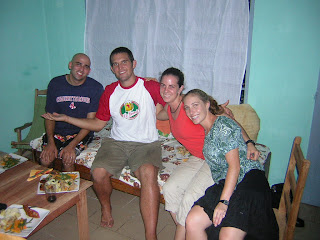 I have settled into my house a little more, which feels good and for which I am also thankful. I completely rearranged things so now guests can sleep in the spare room and the bathroom door closes. Then I moved the kitchen inside so I don’t have to traipse out back to check on my dinner. All of which is good because, of course, last week was Thanksgiving. I have spent many Thanksgivings away from family and friends over the years. None of them was like this one, however. I actually hosted Thanksgiving dinner at my home for the very first time. There were five of us, myself and four other volunteers (see photo), and we all pitched in and made dinner. It was a little difficult finding all the necessary ingredients, but we made do. We had turkey wings (the only turkey we could find that wasn’t frozen so
 lid…or still alive), stuffing (thank you mother for Gerry’s recipe), green beans and carrots, fried potatoes with cheese (REAL cheese!) and apple crisp for dessert (see other photo). I even downloaded a football game on Wednesday so we could watch football after dinner – ‘cause that’s what you do on Thanksgiving. Though it sounds very pedestrian, it was really very special. They talk a lot about Peace Corps being a family, and it sure was this week. For that, I give much thanks!
But that was only the half of it. On Saturday, I ventured out to the town of Ketou (K2) where there was “another Thanksgiving dinner that couldn’t be beat” (thank you, Arlo). There were at least 25 people and everyone brought or made something. There are two volunteers serving in Ketou and we needed both stoves to get everything done in time. This time there was a full bird (killed and plucked for the occasion), two kinds of stuffing (I made Gerry’s recipe again and it was even better the second time because I found sage – called ‘herbs de Provence’ here – while I was shopping on Saturday morning.), mashed potatoes and gravy, au gratin potatoes, green beans, green salad, macaroni salad, rolls, and four or five desserts including pumpkin pie, cherry pie, brownies and coconut cake. A good time, and a good meal, was had by all! And many thanks were given.
Now, if that sounds like a typical T-day weekend, think again. Even here in Cotonou, lots of that stuff is pretty hard to find. Real cheese, for instance, is both uncommon and expensive. And don’t even try to find pasteurized milk. Vegetables are plentiful, although somewhat unpredictable. As you might have picked up on, spices are pretty hit-and-miss, too. You can get Nescafe at just about any store, but trying to find ground coffee is damn near impossible. On Thursday we went looking for oats to make the topping for the apple crisp…nada. We ended up using crumbled up butter cookies. (Much better, by the way!) And getting back and forth is always an adventure, especially if you’re going beyond Cotonou. The road from Pobé to Ketou, which was about the last hour of the 3½ hour trip from Cotonou, is not much more than a glorified dirt road. By the time we got there we were covered in a red-brown dust. But after all, what did you expect? …C’est l’Afrique.
First is the very good news that the folks in Washington, DC have approved our business plan, albeit grudgingly. The message was basically, “There seems to be a framework here for moving forward, but we’re still not convinced that the folks there really understand the job ahead of them.” Duh. This is all entirely new territory here. It’s a completely different paradigm of development and the people I’m working with here are having to come to grips with an elevated set of expectations that they’ve never dealt with before. That’s why it required multiple drafts and the help of an American volunteer before they got the business plan squared away. Nevertheless, we can now move forward with ourreal work; hiring, training and employing arbitrators and mediators to take some pressure off of the court system. For that opportunity, I am thankful. Stay tuned.
All of that happened while I was in the northern town of Natitingou – Nati, for short – for our Early Service Conference. Where the southern part of Benin is lush and humid and mostly green, the north is more arid and dominated by shades of brown. The area around Nati is especially beautiful, being surrounded by rough hills and river valleys. Mind you, what I call hills pass for mountains here in Benin. None of them are over a couple thousand feet high (the highest point in the country is only 600 meters). But they are very rough and angular, not like the nice rounded slopes of the Cascades and their foothills. And the pace is much more laid back than down south, especially Cotonou. It was a really nice break, for which I am also thankful. The conference itself was…well it was fine, except that because I have the least Peace Corps-like job in all of Peace Corps not much of it applied to me. All the other SED volunteers are working with artisans, or women’s groups, or microfinance institutions – all at the grassroots. Me, I’m dealing with bureaucrats – both here and in Washington – and trying to help plan out a national marketing strategy for the Arbitration Center. It’s great for my Masters program, but light years from the “typical” Peace Corps experience.

 I have settled into my house a little more, which feels good and for which I am also thankful. I completely rearranged things so now guests can sleep in the spare room and the bathroom door closes. Then I moved the kitchen inside so I don’t have to traipse out back to check on my dinner. All of which is good because, of course, last week was Thanksgiving. I have spent many Thanksgivings away from family and friends over the years. None of them was like this one, however. I actually hosted Thanksgiving dinner at my home for the very first time. There were five of us, myself and four other volunteers (see photo), and we all pitched in and made dinner. It was a little difficult finding all the necessary ingredients, but we made do. We had turkey wings (the only turkey we could find that wasn’t frozen so
 lid…or still alive), stuffing (thank you mother for Gerry’s recipe), green beans and carrots, fried potatoes with cheese (REAL cheese!) and apple crisp for dessert (see other photo). I even downloaded a football game on Wednesday so we could watch football after dinner – ‘cause that’s what you do on Thanksgiving. Though it sounds very pedestrian, it was really very special. They talk a lot about Peace Corps being a family, and it sure was this week. For that, I give much thanks!
But that was only the half of it. On Saturday, I ventured out to the town of Ketou (K2) where there was “another Thanksgiving dinner that couldn’t be beat” (thank you, Arlo). There were at least 25 people and everyone brought or made something. There are two volunteers serving in Ketou and we needed both stoves to get everything done in time. This time there was a full bird (killed and plucked for the occasion), two kinds of stuffing (I made Gerry’s recipe again and it was even better the second time because I found sage – called ‘herbs de Provence’ here – while I was shopping on Saturday morning.), mashed potatoes and gravy, au gratin potatoes, green beans, green salad, macaroni salad, rolls, and four or five desserts including pumpkin pie, cherry pie, brownies and coconut cake. A good time, and a good meal, was had by all! And many thanks were given.
Now, if that sounds like a typical T-day weekend, think again. Even here in Cotonou, lots of that stuff is pretty hard to find. Real cheese, for instance, is both uncommon and expensive. And don’t even try to find pasteurized milk. Vegetables are plentiful, although somewhat unpredictable. As you might have picked up on, spices are pretty hit-and-miss, too. You can get Nescafe at just about any store, but trying to find ground coffee is damn near impossible. On Thursday we went looking for oats to make the topping for the apple crisp…nada. We ended up using crumbled up butter cookies. (Much better, by the way!) And getting back and forth is always an adventure, especially if you’re going beyond Cotonou. The road from Pobé to Ketou, which was about the last hour of the 3½ hour trip from Cotonou, is not much more than a glorified dirt road. By the time we got there we were covered in a red-brown dust. But after all, what did you expect? …C’est l’Afrique.
Wednesday, October 31, 2007
ET? Phone home.
Happy Halloween!
I have bad news, good news and great news from the past couple of weeks.
The bad news is that my friend and postmate Andy went home. We call it ET’d, which stands for Early Terminated. Early Termination is a purely personal choice and PC does a great job of supporting people who decide to go home. There is no “penalty”; you don’t get a black mark next to your name in the PC ledger or anything. In fact, it is possible to return to PC later to re-apply after you’ve ET’d – many people do. That being said, I’m disappointed both personally at having lost my nearest fellow PCV and professionally because I don’t really think he made a good faith effort to make it work. I won’t go into details because it wouldn’t be appropriate, and I don’t want to judge because as I said ETing is a very personal decision. But I am disappointed.
The good news – though I am perhaps a little ambivalent about it – is that I now have a house full of furniture. Why? Because when Andy left he gave me all of his. I inherited a dining table with four chairs, another coffee table, an end table and three set of shelves: HUGE ones for the living room, medium ones for the kitchen and tall skinny ones for the bathroom. I also got his stove (both his burners work while only one of mine was working), a pagne (PAHN-ya) chair – basically a canvas deck chair – and his single bed frame, but not the mattress. Now I just have to set up the spare room and other volunteers can stay with me when they come to Cotonou. Actually, a few have already done that although the spare bed is currently doubling as my couch. What I really need to do is rearrange the whole place, move my kitchen into the house and use the kitchen space out back for storage – it will make living much easier. So, I guess I know what I’m doing this weekend.
More good news: It looks like I’ve found a secondary project to work on. There is a business school here in Cotonou that is looking for someone to teach some classes on Leadership/Management and the like. One of the other PCVs is going to be teaching some tech classes and she introduced me to the woman who runs the place and it looks like I’ll start teaching in December. That should be fun and it should put me in touch with a different crowd of people; good for broadening the horizons and all.
The great news is that we finished the business plan! Why is this great news? First, it means that LOTS of aid money will now start flowing to the project. We will be able to move into our new office space (getting me out of the lobby) and start hiring and training people to actually DO arbitrations. Second, it means that we can stop operating in “crisis” mode and start working a normal routine. Now at this point I have no idea what that looks like because we’ve been working on the business plan since I got here, so this may or may not be a good thing. I have only a vague idea of what my role will be under normal operating conditions, so we’ll have to play it by ear. Ca va.
Everyday news: Sunday I’m leaving Cotonou for the first time (officially) since swear-in. The Small Enterprise volunteers are all getting together in Natitingou (just like it’s spelled) for our Early Service Conference (ESC). ESC is out first real opportunity to check in and see how things are going for our sector. We’ll get some additional info sessions on funding sources for projects, applying for them, finding secondary projects, etc. But mostly we’ll get to share our experiences with our fellow PCVs. Plus, Nati is way up in the north of Benin, which is totally different from the south. Everyone says it’s just beautiful. I’m REALLY looking forward to a change of scenery right now! I’ll be driving up with a couple of other volunteers and our APCD in a PC vehicle, so instead of cramming into a bush taxi for 14 hours we’ll be riding in a nice, comfy, air-conditioned SUV for 8 or 9. There are some good things about living in Cotonou…
Next time, more pictures!
I have bad news, good news and great news from the past couple of weeks.
The bad news is that my friend and postmate Andy went home. We call it ET’d, which stands for Early Terminated. Early Termination is a purely personal choice and PC does a great job of supporting people who decide to go home. There is no “penalty”; you don’t get a black mark next to your name in the PC ledger or anything. In fact, it is possible to return to PC later to re-apply after you’ve ET’d – many people do. That being said, I’m disappointed both personally at having lost my nearest fellow PCV and professionally because I don’t really think he made a good faith effort to make it work. I won’t go into details because it wouldn’t be appropriate, and I don’t want to judge because as I said ETing is a very personal decision. But I am disappointed.
The good news – though I am perhaps a little ambivalent about it – is that I now have a house full of furniture. Why? Because when Andy left he gave me all of his. I inherited a dining table with four chairs, another coffee table, an end table and three set of shelves: HUGE ones for the living room, medium ones for the kitchen and tall skinny ones for the bathroom. I also got his stove (both his burners work while only one of mine was working), a pagne (PAHN-ya) chair – basically a canvas deck chair – and his single bed frame, but not the mattress. Now I just have to set up the spare room and other volunteers can stay with me when they come to Cotonou. Actually, a few have already done that although the spare bed is currently doubling as my couch. What I really need to do is rearrange the whole place, move my kitchen into the house and use the kitchen space out back for storage – it will make living much easier. So, I guess I know what I’m doing this weekend.
More good news: It looks like I’ve found a secondary project to work on. There is a business school here in Cotonou that is looking for someone to teach some classes on Leadership/Management and the like. One of the other PCVs is going to be teaching some tech classes and she introduced me to the woman who runs the place and it looks like I’ll start teaching in December. That should be fun and it should put me in touch with a different crowd of people; good for broadening the horizons and all.
The great news is that we finished the business plan! Why is this great news? First, it means that LOTS of aid money will now start flowing to the project. We will be able to move into our new office space (getting me out of the lobby) and start hiring and training people to actually DO arbitrations. Second, it means that we can stop operating in “crisis” mode and start working a normal routine. Now at this point I have no idea what that looks like because we’ve been working on the business plan since I got here, so this may or may not be a good thing. I have only a vague idea of what my role will be under normal operating conditions, so we’ll have to play it by ear. Ca va.
Everyday news: Sunday I’m leaving Cotonou for the first time (officially) since swear-in. The Small Enterprise volunteers are all getting together in Natitingou (just like it’s spelled) for our Early Service Conference (ESC). ESC is out first real opportunity to check in and see how things are going for our sector. We’ll get some additional info sessions on funding sources for projects, applying for them, finding secondary projects, etc. But mostly we’ll get to share our experiences with our fellow PCVs. Plus, Nati is way up in the north of Benin, which is totally different from the south. Everyone says it’s just beautiful. I’m REALLY looking forward to a change of scenery right now! I’ll be driving up with a couple of other volunteers and our APCD in a PC vehicle, so instead of cramming into a bush taxi for 14 hours we’ll be riding in a nice, comfy, air-conditioned SUV for 8 or 9. There are some good things about living in Cotonou…
Next time, more pictures!
Sunday, October 21, 2007
Of Past and Present
It’s been a very frustrating week so I thought I’d take my mind off of it by telling you all a little bit about the history of Benin. As some may know, Benin was the very heart of what was once known as the “Slave Coast.” Not surprisingly, it earned that name because hundreds of thousands of Africans were transported from Benin, mostly from the port of Ouidah (WEE-da), to Europe and the Americas. Ouidah also happens to be the spiritual capital of the Vodun faithful. The word Vodun is from the Fon language and it is the source of the English word Voodoo. The practice of Vodun was brought from West Africa to the Americas by slaves and became what we know as Voodoo.
 During our training we took a day trip to Ouidah and it was fascinating. Our first stop was the Historical Museum, which is housed in a former Portuguese fort. At one time the Portuguese conducted slave auctions within the walls of the compound. The fort served as the site of the diplomatic presence of Portugal in the area until it was annexed by the government of Dahomey in 1961. After taking possession of the fort the Dahomean government began restoration, and in 1967 the fort became the Ouidah Museum of History. Most of the collections are housed in the former Portuguese representative’s residence. Unfortunately, photos are only allowed outside the buildings.

 One of the focal points for Vodun is the Sacred Forest. (As always, trees play a pivotal role in my many travels – I should probably meditate on why that is.) It is perhaps the most hallowed place in Ouidah. The photo at left is of me standing at the entrance to the Sacred Forest. According to the most popular version of the story, sometime around 1550 Kpasse became the second king of Savi (9 km north of Ouidah) and founded the city of Ouidah. When he learned that two jealous enemies were plotting his demise, he alerted his two sons, telling them that although he would never die, he would disappear one day. If he should not come out of his room before sunset, he told them, his sons were not to open the door but to understand that he was already gone. After nine days they would see a specific sign from their father which, once understood, would protect them and their families for generations to come. One day these events did come to pass. Today, the sign is still a secret known only to the direct descendants of the king.
 Soon after King Kpasse disappeared, his family living in Savi saw a bird they had never seen before. It led them to the Sacred Forest in Ouidah where, upon entering the grounds of the forest, the bird turned into two growling panthers (male and female). The family was frightened until they heard the voice of the king. He gave them an important message: if at any time they were having problems, they could come to the forest and pray to a specific tree in
  which his spirit would live forever. The tree was then just a little sprout next to a sacred clay pot. Today, behind the ruins of the old French administrative house in the forest, abandoned because the spirits were "too strong" for the French, stands an enormous iroko tree. One also finds active shrines, including a clay pot, next to the tree in which Kpasse's spirit still resides.
Perhaps the most moving, and the most troublesome, feature of contemporary Ouidah is the “Slave Route.” Whether it is the actual route the departing slaves followed or not is less important than what it represents in terms of a didactic experience for both visitors and Beninese alike. As a reinvention of various aspects of the slave trade from the Ouidah port, the Slave Route appeals to visitors on an emotional level as it follows the footsteps of African captives who walked the three miles to the beach and then onto ships destined for the Americas. The route is marked at critical points by sculptures and monuments depicting the atrocities of the slave trade.
The Slave Route officially begins under a large tree (there it is again), where the public auctions are said to have been held. The tree is located just behind the compound of Don Francisco de Souza, who was born in Brazil in 1754 and died in Ouidah in 1849. De Souza, whose father was Portuguese and whose mother was an Amerindian from Brazil, arrived in Ouidah in 1788 and was intimately involved in the transatlantic slave trade for over 60 years. He was named Viceroy of Ouidah by his friend and collaborator, King Ghezo of Abomey. De Souza's influence in the trade spread east to Nigeria and west to Togo. At the height of his involvement he is said to have supplied more than 100 slave ships traveling between the west coast of Africa and the Americas. Today, the name de Souza is among the most numerous in Benin, as Don Francisco had a dozen wives and about 40 children. Our guide during our trip was a woman named Martine de Souza, who had moved away from the de Souza compound just two years ago.
 The next major site on the route is the Tree of Forgetting. Sadly, the tree itself is no longer there. The place where the tree is believed to have stood is marked with a sculpture of a three-headed, three-footed, three-armed Vodun spirit called Mami Wata and a small symbolic tree The story goes that all of the enslaved women marched around this tree seven times, and all of the enslaved men, nine times. The intent was to make them forget their origins and cultural identities. In that way they would lose the yearning to return to their homeland and acquiesce more readily to slave life. This process has been compared to the ritual of “zombification” rumored to exist in Haiti, wherein the work of the sorcerer forces one to lose ones identity and become a “living dead.” The failure of this idea is evident in the fact that such identities thrived and continue to thrive in African diasporas throughout the Americas (witness the continued popularity of the Voodoo faith).
 After encircling the Tree of Forgetting, the captives are said to have been led to the Zomai Enclosure. The name, translated as "a place where fire can never go," refers to the darkness of the rooms inside. The building itself is no longer standing, but the spot is now commemorated with a contemporary memorial: a sculpture composed of different faces bearing different scarification markings, representing the many enslaved Africans from a variety of ethnic backgrounds who converged in this dark place before they were sent across the ocean. The six Yoruba markings (three on each cheek), and the ten Fon markings (two on each cheek, temples, and forehead) are readily discernible (click photo at left). The piece also includes a scale to represent the ideal of equality among peoples throughout the world.
 The customs house, located in the Zoungbodji quarter of the city, controlled and recorded the movement of enslaved Africans from the Abomey kingdom to the coast. A monument is constructed upon what is believed to be the common grave for slaves who died in the Zomai Enclosure, although there have been no archaeological excavations to prove or disprove this theory. To the rear of a rectangular plaza is a large abstract mosaic mural. Black is used to represent Africans chained together, with blood in red, against a white background (click photo).
 Before arriving at the beach where they would be loaded onto ships bound for the Americas, the captives are said to have made one last stop along the Slave Route, at the Tree of Return. This point on the route is represented by an actual tree (!), variously reported to be the real Tree of Return or to have been planted in Ouidah during the reign of King Agaja of Abomey (1708-1732). The enslaved Africans are said to have walked around the tree three times to ensure that their spirits, if not their bodies, would return to their native land.
 With the Atlantic Ocean as an ominous backdrop, the final monument along Slave Route is the Door of No Return. In the center is a massive arch, built atop a large circular platform. On the upper facing of the arch are four bas-relief sculptures showing of two rows of Africans chained together, converging upon the beach with the ocean in front of them. Different perspectives of this same scene ornament
  the front, back, and both sides of the entablature. The columns supporting the arch consist of pairs of kneeling male and female figures repeated from the bottom to the top. One either side, four abstract metal sculptures depict families and Africans broken free of chains who wave good-bye.
Every January 10th since 1993, Benin has celebrated National Vodun Day. The festival's main activity is the reenactment of the slave march to the beach. The procession honors the memory of those ancestors lost in the slave trade and celebrates those who survived and passed down the culture and practices of West Africa that flourish today throughout the African Diaspora. Thus, the art and monuments are both historical markers and active ancestral shrines.
 During our training we took a day trip to Ouidah and it was fascinating. Our first stop was the Historical Museum, which is housed in a former Portuguese fort. At one time the Portuguese conducted slave auctions within the walls of the compound. The fort served as the site of the diplomatic presence of Portugal in the area until it was annexed by the government of Dahomey in 1961. After taking possession of the fort the Dahomean government began restoration, and in 1967 the fort became the Ouidah Museum of History. Most of the collections are housed in the former Portuguese representative’s residence. Unfortunately, photos are only allowed outside the buildings.
 One of the focal points for Vodun is the Sacred Forest. (As always, trees play a pivotal role in my many travels – I should probably meditate on why that is.) It is perhaps the most hallowed place in Ouidah. The photo at left is of me standing at the entrance to the Sacred Forest. According to the most popular version of the story, sometime around 1550 Kpasse became the second king of Savi (9 km north of Ouidah) and founded the city of Ouidah. When he learned that two jealous enemies were plotting his demise, he alerted his two sons, telling them that although he would never die, he would disappear one day. If he should not come out of his room before sunset, he told them, his sons were not to open the door but to understand that he was already gone. After nine days they would see a specific sign from their father which, once understood, would protect them and their families for generations to come. One day these events did come to pass. Today, the sign is still a secret known only to the direct descendants of the king.
 Soon after King Kpasse disappeared, his family living in Savi saw a bird they had never seen before. It led them to the Sacred Forest in Ouidah where, upon entering the grounds of the forest, the bird turned into two growling panthers (male and female). The family was frightened until they heard the voice of the king. He gave them an important message: if at any time they were having problems, they could come to the forest and pray to a specific tree in
 which his spirit would live forever. The tree was then just a little sprout next to a sacred clay pot. Today, behind the ruins of the old French administrative house in the forest, abandoned because the spirits were "too strong" for the French, stands an enormous iroko tree. One also finds active shrines, including a clay pot, next to the tree in which Kpasse's spirit still resides.
Perhaps the most moving, and the most troublesome, feature of contemporary Ouidah is the “Slave Route.” Whether it is the actual route the departing slaves followed or not is less important than what it represents in terms of a didactic experience for both visitors and Beninese alike. As a reinvention of various aspects of the slave trade from the Ouidah port, the Slave Route appeals to visitors on an emotional level as it follows the footsteps of African captives who walked the three miles to the beach and then onto ships destined for the Americas. The route is marked at critical points by sculptures and monuments depicting the atrocities of the slave trade.
The Slave Route officially begins under a large tree (there it is again), where the public auctions are said to have been held. The tree is located just behind the compound of Don Francisco de Souza, who was born in Brazil in 1754 and died in Ouidah in 1849. De Souza, whose father was Portuguese and
 whose mother was an Amerindian from Brazil, arrived in Ouidah in 1788 and was intimately involved in the transatlantic slave trade for over 60 years. He was named Viceroy of Ouidah by his friend and collaborator, King Ghezo of Abomey. De Souza's influence in the trade spread east to Nigeria and west to Togo. At the height of his involvement he is said to have supplied more than 100 slave ships traveling between the west coast of Africa and the Americas. Today, the name de Souza is among the most numerous in Benin, as Don Francisco had a dozen wives and about 40 children. Our guide during our trip was a woman named Martine de Souza, who had moved away from the de Souza compound just two years ago.
 The next major site on the route is the Tree of Forgetting. Sadly, the tree itself is no longer there. The place where the tree is believed to have stood is marked with a sculpture of a three-headed, three-footed, three-armed Vodun spirit called Mami Wata and a small symbolic tree The story goes that all of the enslaved women marched around this tree seven times, and all of the enslaved men, nine times. The intent was to make them forget their origins and cultural identities. In that way they would lose the yearning to return to their homeland and acquiesce more readily to slave life. This process has been compared to the ritual of “zombification” rumored to exist in Haiti, wherein the work of the sorcerer forces one to lose ones identity and become a “living dead.” The failure of this idea is evident in the fact that such identities thrived and continue to thrive in African diasporas throughout the Americas (witness the continued popularity of the Voodoo faith).
 After encircling the Tree of Forgetting, the captives are said to have been led to the Zomai Enclosure. The name, translated as "a place where fire can never go," refers to the darkness of the rooms inside. The building itself is no longer standing, but the spot is now commemorated with a contemporary memorial: a sculpture composed of different faces bearing different scarification markings, representing the many enslaved Africans from a variety of ethnic backgrounds who converged in this dark place before they were sent across the ocean. The six Yoruba markings (three on each cheek), and the ten Fon markings (two on each cheek, temples, and forehead) are readily discernible (click photo at left). The piece also includes a scale to represent the ideal of equality among peoples throughout the world.
 The customs house, located in the Zoungbodji quarter of the city, controlled and recorded the movement of enslaved Africans from the Abomey kingdom to the coast. A monument is constructed upon what is believed to be the common grave for slaves who died in the Zomai Enclosure, although there have been no archaeological excavations to prove or disprove this theory. To the rear of a rectangular plaza is a large abstract mosaic mural. Black is used to represent Africans chained together, with blood in red, against a white background (click photo).
 Before arriving at the beach where they would be loaded onto ships bound for the Americas, the captives are said to have made one last stop along the Slave Route, at the Tree of Return. This point on the route is represented by an actual tree (!), variously reported to be the real Tree of Return or to have been planted in Ouidah during the reign of King Agaja of Abomey (1708-1732). The enslaved Africans are said to have walked around the tree three times to ensure that their spirits, if not their bodies, would return to their native land.
  With the Atlantic Ocean as an ominous backdrop, the final monument along Slave Route is the Door of No Return. In the center is a massive arch, built atop a large circular platform. On the upper facing of the arch are four bas-relief sculptures showing of two rows of Africans chained together, converging upon the beach with the ocean in front of them. Different perspectives of this same scene ornament
  the front, back, and both sides of the entablature. The columns supporting the arch consist of pairs of kneeling male and female figures repeated from the bottom to the top. One either side, four abstract metal sculptures depict families and Africans broken free of chains who wave good-bye.
 Every January 10th since 1993, Benin has celebrated National Vodun Day. The festival's main activity is the reenactment of the slave march to the beach. The procession honors the memory of those ancestors lost in the slave trade and celebrates those who survived and passed down the culture and practices of West Africa that flourish today throughout the African Diaspora. Thus, the art and monuments are both historical markers and active ancestral shrines.
Saturday, October 20, 2007
First Pictures!
 Here's a picture of most of this year's cadre of volunteers here in Benin. I say most because we didn't realize there were a few folks missing before we snapped the shot. That's me in the middle of the back row with my head turned to the side. Oh well...
Now that I've figured out how to post photos I'll go back and update some past posts with pictures. You can always click on a photo to see it full-size. I may also try to add video of the chicken slaughter, but it's pretty big so no guarantees.

This shot is of me with my host papa Bertin Alladayé and his brother Robert, in Azové. Bertin is on the right and Robert on the left. This was taken on one of our many forays around the drinking establishments of Azové.
Subscribe to:
Posts (Atom)